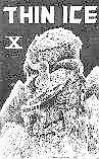
| Taped to Tomorrow This short story in the horror genre was published in the tenth issue of Thin Ice. Story copyright 1991, William D. Cissna. The money was burning a hole in Dennis Nelson's pocket. It hadn't come easy, that money. He'd had to work all summer, cutting grass, digging gardens, trimming trees. A hell of a way for a fourteen-year-old boy to spend the summer. But then the folks had surprised him with a few extra bucks for his birthday. With what he'd saved over three months, he thought it might just be enough. He'd always wanted a tape recorder, a real tape recorder with reel-to-reel like his Dad's, not one of those cheap things with 8-track or cassette. Ever since April, when he'd walked home the way he wasn't supposed to, through the part of town his old lady always referred to as "tough," and seen the unit in the dirty window of the old pawn shop, he knew exactly where to find it. He'd walked by that store once a week, peering through the grimy windows at the gadget sitting on a display riser. On top of a dog-eared cardboard box, it looked well used, but Dennis could tell it had once cost a lot of money. It had all the switches and gears of the big ones he'd seen in the stereo store at the mall. After a time, he could tell the old man who hung out in the dark at the back of the shop knew Dennis, maybe even what Dennis wanted. By July, he just nodded when Dennis stuck his face up to the window. The recorder hadn't moved as much as an inch during the whole summer. One day in August, he thought he saw a cobweb dangling from the side wall to one of the prongs holding the reels in place. Finally, fall came and he started to make extra bread raking leaves. Now the money was a wad in his right pants pocket as he walked cautiously along the curbline, desperately trying to look taller than his five feet, two inches. Though he normally ignored anything she said, his mother might be right this time. The area did look tough. He didn't want to get mugged or shot or something. He looked back frequently to be sure no one followed him. He scuffed his feet through the scattered, crumpled newspapers lining the sidewalk as he made the last turn into the narrow, crowded street where the pawn shop hid between Gino's Bar and a movie theater with flashing neon. Even at ten in the morning, the lights were on. For the first time, he didn't stop at the window but marched down the five stairs to the brass-and-wood door that announced "Samuel P. Foster. We Pawn." He grabbed the sticky doorknob, pulling the door towards him. Stepping across the threshold, he squinted in the dim light, until shapes became recognizable. With a deep breath, he weaved through the accumulated detritus of a thousand lives, heading back to where he'd seen the old man. The workings of an aged office chair screamed out in protest when the man spun around to greet his young customer. Hands shook as they reached across the desk to grasp rimless glasses and affix them to a lined face. A smile of recognition came to the bloodless lips. "Welcome," said Samuel P. Foster. "I wondered when you'd come inside." "You knew I would some day, I suppose," Dennis said. "I suppose I did. You had that 'I want it' look in your eyes." "Old men are wise, I've heard." "That's one of the things old men can be," Samuel Foster said. "You're going to take the tape recorder then?" "Yes." "You don't even know how much it is." "I think I have enough." "You probably do. Listen, young man, it doesn't cost a lot, but it's not easy to operate. I haven't had much luck myself." "I'll give it a try anyway." "Your choice. Okay. With the box of tapes, I'm asking twenty bucks. Can you handle that?" A thrill of excitement coursed through Dennis. He had expected to pay three or four times as much. Could he handle it? "I was thinking more like fifteen." "Sure you were. I'll stick to twenty." "Oh, alright, I'll go the twenty, but if it doesn't work, I want the money back, okay?" "Fair enough. But somehow I think you'll figure it out." Carrying the tape recorder home turned out to be more of a challenge than he'd anticipated. The old man insisted the carton of ancient tapes -- packed in yellowing-white cardboard boxes -- were part of the package. If it hadn't been for the handle on the recorder's protective case, he might not have made it. As it was, his arms nearly pulled out of their sockets before he rounded the corner to his house. Relief pulsed through his muscles when he dumped the box unceremoniously on his bed and carefully lowered the recorder to the floor. He paused only long enough to wipe sweat from his face before placing the recorder in a position of honor on the corner of his desk. He crawled beneath it, yanking the cord behind the desk and plugging it in. Then came magic time. He sat in his rotating chair, flicked a dusty switch to "on." A low hum invaded the room as dim white lights illuminated the VU meters. He stared in awe at the multiple switches, considering his options. The large handle at the lower right, with a variety of commands -- FF, REW, PLAY, REC, STOP -- seemed to open a world of opportunities. He reached into the box, pulled out a slightly-warped, plastic take-up reel. Reverently, he slid it into place on the right-hand tape position and debated for a moment, deciding the old tapes probably wouldn't hurt the machine -- at least until he could buy new ones. The top box was identified by a large, black "P1" in one corner and a check in the box next to 7-1/2 IPS. He set the speed indicator to match, wound the tape down through the heads and back up onto the empty take-up reel. Fingers crossed, he turned the main control knob from STOP to PLAY. Without hesitation, the reels floated into motion as the heads clamped down on the tape. He set the volume at 5. For about ten seconds, it seemed as thought the tape might be blank. Then Dennis Nelson's world turned upside down. Watching the tape run through the recorder, he suddenly realized the walls around him had started to fade. He rubbed his eyes to clear his vision. When he opened them, the desk, too, had faded. He had the feeling he wasn't in the house anymore, a feeling confirmed when he looked down and saw his chair had become a huge boulder. Raising his eyes, he found suburbia had given way to thick, lush vegetation surrounding his seat on all sides. "What the hell is going on?" he said, only to find that, while the thought passed through his mind quite clearly, his voice made no sound. At that moment, a couple emerged from the undergrowth. Embarrassed, Dennis covered his eyes, for the couple was naked. When he uncovered them, the couple was still there, talking in a language he couldn't understand. They didn't seem to notice he was watching. Between them, accompanied by many gestures, passed an apple. Bang! A flash of light and a booming voice came from the sky. The couple cowered, shaking in fear. When the voice ceased, they walked from the clearing, heads bowed, ashamed. Dennis watched until they were out of sight. As he racked his brain for understanding, the scene blurred, images rushed by his eyes, reminding him of video transitions in TV shows he had seen. When it stopped and he could focus again, he saw that he sat cross-legged atop a carefully-hewn stone block. Across a sandy waste the length of a football field, hundreds of sun-baked men struggled with immense ropes, dragging similar blocks up a large sculpture that climbed towards the sky. Nearby, a huge cat-like structure crouched as if guarding the site. Dennis gaped and tried, without success, to shout to the workers. The vision smeared again, unsettled, and was gone. When he could see, he sat in the midst of a loud, cheering crowd in an amphitheater sloping sharply towards a central pit. Everywhere were colorful banners, men in uniforms, women in flowing white robes. Everyone's attention was turned towards a gaily-decorated box of seats above and to the right of him. Turning to look, he saw a seated fat man extend one arm, hand closed in a fist. The crowd went silent. Dennis tried to tap the nearest man on the arm, draw his attention, but his hand was like thin air, passing through flesh as if he didn't exist. The fat man's thumb popped free from the fist, held for a dramatic moment, then plunged downward. Attention immediately returned to the pit as an animal-like yell went up from the crowd. In the center below, a small group of men huddled together. Men seated on the high walls surrounding the pit yanked on chains. Three large gates rode slowly upward, releasing snarling inmates. As Dennis stared in horror, fifteen lions leapt on their prey ... the tape snapped out of the reel, flapping noisily. Stunned, Dennis sat on the swivel chair, in his room, looking at the tape recorder. What kind of beast is this, he wondered. Is it bad; will it hurt me when I play it? And do I dare? He turned it off and got out his tool kit. Carefully, he removed the protective cover plate to gaze at the inner workings. He'd never seen anything like it. The machine, if he was counting correctly, had seven playback heads. Not one of them was in alignment with the next. He flicked the recorder back on, punched PLAY, and watched the drive shafts run. It probably played parts of a tape no one had ever considered using before. On a whim, he grabbed the tape, ran downstairs to his father's den. He put the tape on his father's expensive deck -- after checking to be sure Dad wasn't around -- and turned it on. One of the BOSE speakers boomed a big band version of "Happy Days Are Here Again." No change of scenery. No visions. Just music. So it was the recorder as well as the tapes. He ran back up to his room, slamming the door shut -- protectively. It took five hours to play through tapes P2, P3, P4 and P5. By the time Melva Nelson called Dennis for dinner, he had sat through patches of the Dark and Middle Ages, the Ming Dynasty, the white settlement of the Americas, the Industrial Revolution and enough wars to have lost count. His head whirled with possibilities as he gulped down lasagna. "Where have you been today?" Arthur Nelson asked his son. "You wouldn't believe me if I told you," Dennis replied, excusing himself to return upstairs. Arthur glanced at Melva, raising his eyebrows. She shrugged, mentally noting she needed to have a talk with her son sometime soon. Dennis pondered the significance of his off-the-cuff comment to his father. There, indeed, was the crux of the matter. What was the point of having seen the Beatles live at the Cavern in 1962 if he couldn't tell someone about it, much less have him believe it? So much yet to learn. Maybe he could let someone else take the trips, or maybe it didn't work that way. But if it did ... maybe he could learn to edit the tapes -- pick and choose the good parts, leave the bad ones in the box. Then ... then he could charge admission. Sure! He could see it in his mind: Dennis Nelson's Time-Travel Tapes. Sign Up for the Trip You've Never Taken! See Rome Before It Was Ruins! Experience the Bubonic Plague Painlessly! Join the Troops at Valley Forge ... without the Shivers! The possibilities were immense. He reached into the box for the next tape. It had no lettering or identification of any kind on the outside. He put it on the recorder, played it. Nothing happened. He went through more tapes. Same result. He pulled the last one out of the box. It was marked with a large, red "F" in the upper right-hand corner. He threaded it onto the machine, flicked the switch to PLAY. It worked. Dennis sat in a chair made of white wire mesh, comfortable but not -- as far as he could see -- connected to the floor in any manner whatsoever. On one arm of the chair was a round knob and several switches, like the control arms on video games. Next to them, an on-off switch rested at "on." Tentatively, he fingered the toggle closest to him, then pushed it slightly forward. The chair silently, smoothly moved in that direction. On air? He turned the knob to the left; the chair angled in that direction, still moving forward. Soon he had the knack of it and ran the chair around the empty, cavernous room until he reached the huge floor-to-ceiling windows lining one end. He stopped to stare through the glass, past the marble columns and out onto the city below. It didn't surprise him to see sleek, two-door, silver vehicles flitting along the streets three feet above the ground. What surprised him was a building resembling every old monumental structure he'd ever seen. Then he caught sight of the famed obelisk, the white, low buildings near it. He recognized them, knew why the city's architecture hadn't changed much. National landmarks rarely did. Before him were the Washington, Jefferson and Lincoln. He looked out on the nation's capital. A thought crept up from his subconscious. The vehicles he saw were moving in only one direction -- away from the center of town. Rapidly. Chaotically. Sometimes crashing into each other. The sun shone brightly, nearly overhead. It couldn't be rush hour. He rose gingerly from the chair to open one of the low doors before him, walked out onto a wide, paved patio. On his right, the river placidly flowed by. On its bridges, traffic snarled into a honking, screaming mess. Too bad they had yet to figure out how to alter the hover height of the new "cars," Dennis mused. Traffic would move better. A voice reminding him of the voice on his first taped trip in the Garden issued from loudspeakers, not from God. Not yet, anyway. "Citizens of the District of Columbia," it boomed, "please do not panic. We have been promised a message from your President in exactly ten minutes. The rumor that negotiations with the other powers to avert threatened nuclear confrontation have broken down is nothing more than that -- rumor! We do not believe war is imminent. Please be calm and await further instructions!" You could hear the panic in the man's voice, Dennis thought. What a trip! Was it really going to happen? A middle-aged man sat on a marble bench near the end of the patio. Nero during the fire, Dennis thought, walking towards him. When close enough, he called out, "What the heck's going on, Mister? Is the world coming to an end?" The man looked up at the questioning young face. "I hope you're not joking, young man. This is very serious indeed -- and may, in fact, truly be the end of the world. I think somebody, somewhere, is about to push the button. Somebody else will push one, too, so his country isn't left out. The various former Russian countries are scared of us; the Chinese are scared of everyone; the Arabs couldn't care less one way or the other -- and we're scared of all of them. A very serious problem about to come to an end." "Oh," Dennis said, crestfallen. He hadn't thought about this as real life, had only viewed the events as if watching television. "I suppose you want to be alone," he said. The man nodded. Dennis walked away, back to the big windows. Then it struck him. He had talked with the man, held a conversation. He reached out, touched the marble balustrade along the outer edge of the patio. Despite the sun, it was cool. That meant he was very much a part of all this. No innocent bystander merely watching, observing, then disappearing. Unless the tape ended damn soon, he would be here for the duration of ... of whatever was going to happen. His knees gave out, and he sat down hard on the stone wall. The loudspeaker, which he had sighted high up in the limbs of a nearby tree, crackled expectantly. The voice, deadly serious and painfully familiar, spoke. "Citizens of the District of Columbia, I give you ... the President of the United States of America." A pause was followed by a thin voice, panicked and made thinner by apparent distance. "My friends, I fear I am the bearer of bad tidings. I am speaking to you from Air Force One, flying high above this great nation of ours." "Oh, shiiii-iitt," screamed the solitary man on the patio. "We are in for it now." "Earlier today, I was informed by leaders of several other great nations that, and I quote, 'the time for negotiations has ended and the time for action has come.' Unfortunately, they have chosen to make their actions clear at this time. We consider ourselves in a state of war and ..." The words broke in a spurt of static, then silence. "Forgive me. We have just received word a nuclear attack force has been unleashed upon our nation by several countries. Some are also apparently attacking each other. We have no option but to join in this madness. I wish you the best in whatever world remains when this ends." As if to punctuate his words, a loud roaring went up from the surrounding countryside as missile after missile in the district defense corridor took to the skies, aimed towards the decimation of God only knew what cities in the eastern European, Asian and Arab blocs. Dennis sat on the ground -- beyond belief -- as, around him, millions of citizens endeavored in vain to escape the city. It was only a matter of time. How far could they get? Seconds ticked by like dripping molasses as he awaited the inevitable. Soon enough, the moment came: out of the sky appeared burning projectiles, speeding at unbelievable rates towards the center of the city. And ... they stopped. As he watched, still unbelieving, the missiles hung in mid-air. Silence surrounded him as he struggled to under-stand what was happening. Consciously deciding to scratch his head, he made a final discovery: he, too, was immobile. Just as were the cars, the air, the people clustered on the sidewalks, the man on the bench -- he could not, would not, move. *** In the cluttered bedroom, Melva Nelson stood in front of her son's desk, her fingers resting on the tape recorder's toggle switch. The recorder lights were off, as was the machine. "How many times have I told you not to waste electricity, Dennis?" she said loudly. Although she couldn't see him, she knew he must be hiding somewhere in the room. "When you leave the room, turn things off, dagnab it!" Unmoving, the tape was only ten revolutions from its end. *** Ten months after the Nelsons filed a missing-person's report, an old man appeared at the door. "Mrs. Nelson?" he asked politely. "Yes?" "I'm sorry to bother you, but your son bought an item from me some time ago, and I'd like to have it back. I'm Sam Foster, run the pawn shop in town." "Oh, it must be that tape recorder." She looked away for a moment, swiping at tears. "My husband has a much better one. I'm sure he'll let Denny use it when he returns. Please come in." She led the old man upstairs into the room, where nothing had changed. He walked to the recorder and carefully, expertly, rewound the tape to the beginning, removed it and returned it to the dirty box. Silently, he handed the woman twenty dollars and carried away the recorder and tapes. The next morning, the recorder was atop the cardboard box on the display riser. On the door to the shop, it said, "Samuel P. Foster. We Pawn." In the back, the old man waited ... patiently. *** |
Horror shorts -
by Bill Cissna
by Bill Cissna
 |
 |
 |
 |
 |
 |
 |
| To return to the main fiction page, click here. |